1.5 Solving Polynomial Equations with a GDC
SL 1.8
- the words polynomial, degree, coefficient, root and zero
- how to write a polynomial equation in the form \(p(x) = 0\), with the powers in descending order
- how to solve polynomial equations with Find Roots of Polynomial, and with a graph on the TI-Nspire CX II
- how many real roots a polynomial equation can have
- how to interpret the roots in context, and how to reject roots that do not make sense
Polynomials, roots and zeros
A polynomial in \(x\) is a sum of terms of the form \(a x^n\), where each power \(n\) is a whole number (\(0, 1, 2, \ldots\)).
Polynomials Not in the formula booklet
\[ p(x) = a_n x^n + a_{n-1} x^{n-1} + \cdots + a_1 x + a_0 , \qquad a_n \neq 0 \]
- \(n\): the degree of the polynomial (the highest power of \(x\))
- \(a_n, a_{n-1}, \ldots, a_0\): the coefficients (numbers); \(a_n\) is the leading coefficient
- \(a_0\): the constant term
| Degree | Name | Example |
|---|---|---|
| \(1\) | linear | \(3x - 7\) |
| \(2\) | quadratic | \(2x^2 + 3x - 7\) |
| \(3\) | cubic | \(x^3 - 2x^2 - 5x + 6\) |
| \(4\) | quartic | \(x^4 - 5x^2 + 2x + 1\) |
The words root and zero describe the same numbers in two ways:
- the roots of the equation \(p(x) = 0\) are its solutions;
- the zeros of the function \(p\) are the values of \(x\) where \(p(x) = 0\);
- on the graph \(y = p(x)\), the real zeros are the \(x\)-intercepts: the points where the graph meets the \(x\)-axis.
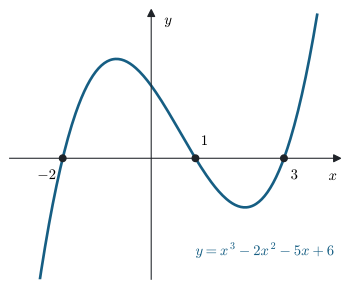
How many real roots? Not in the formula booklet
A polynomial equation of degree \(n\) has at most \(n\) real roots. A quadratic equation can have \(2\), \(1\) or \(0\) real roots. A cubic equation always has at least \(1\) real root.
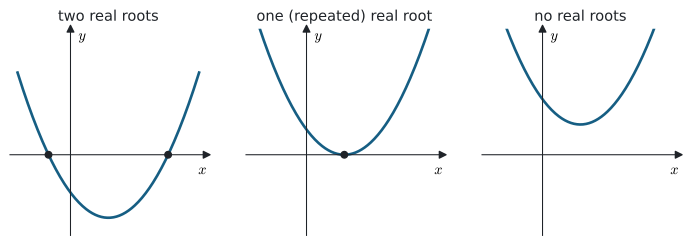
In everyday English, “real” and “imaginary” have their usual meanings. In mathematics they are technical words. An equation with no real roots still has roots that are complex numbers. At SL you only need real roots. Complex roots are studied at HL in Unit 5.
Solving with Find Roots of Polynomial
Before you use the graphic display calculator (GDC), write the equation in the form \(p(x) = 0\):
- Move every term to one side, so that the other side is \(0\).
- Write the terms in descending powers of \(x\).
- If a power is missing, its coefficient is \(0\).
On a Calculator page:
- Menu → Algebra → Polynomial Tools → Find Roots of Polynomial.
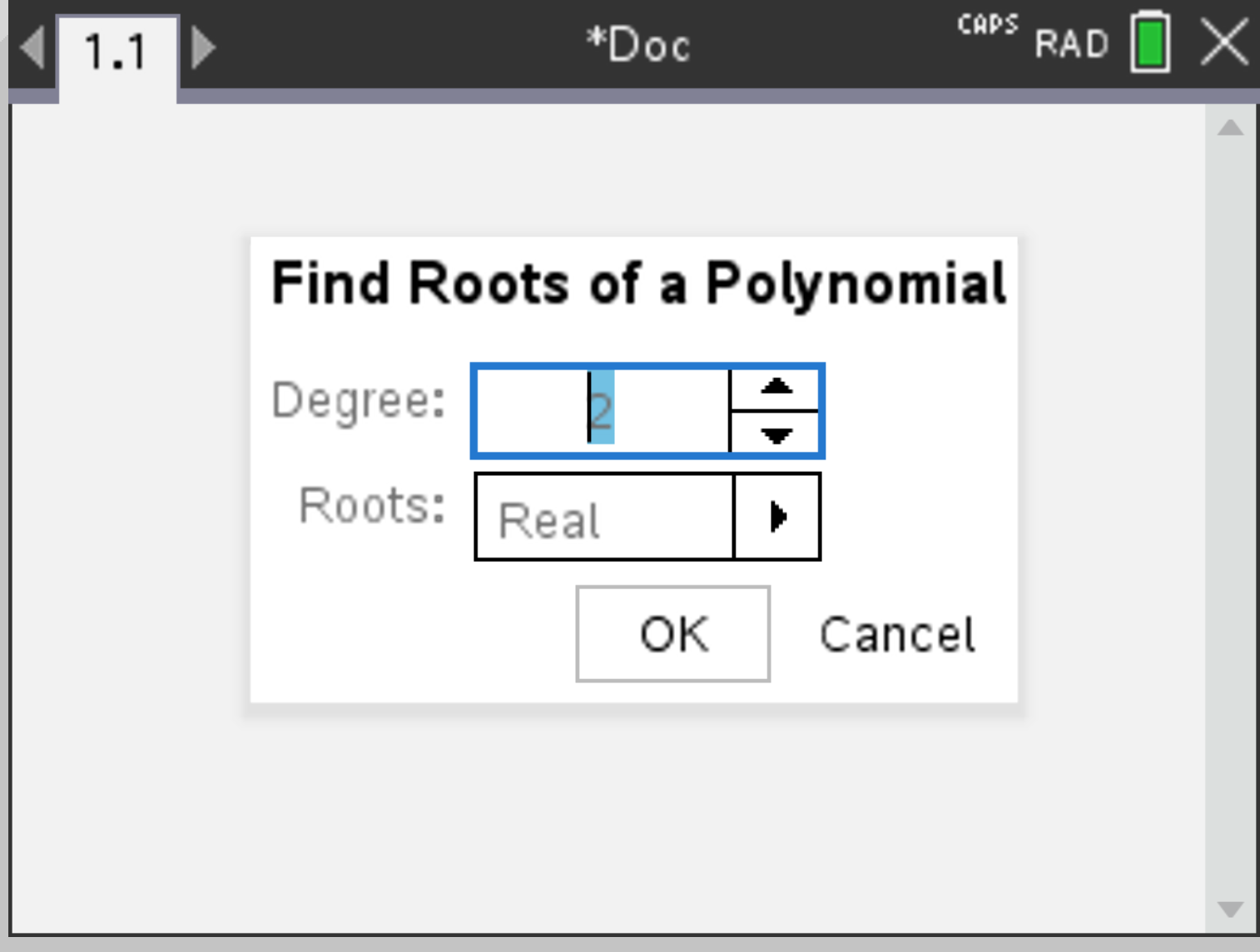
- The box Find Roots of a Polynomial opens. Set Degree (for example \(3\)).
- Set Roots to Real. Choose OK.
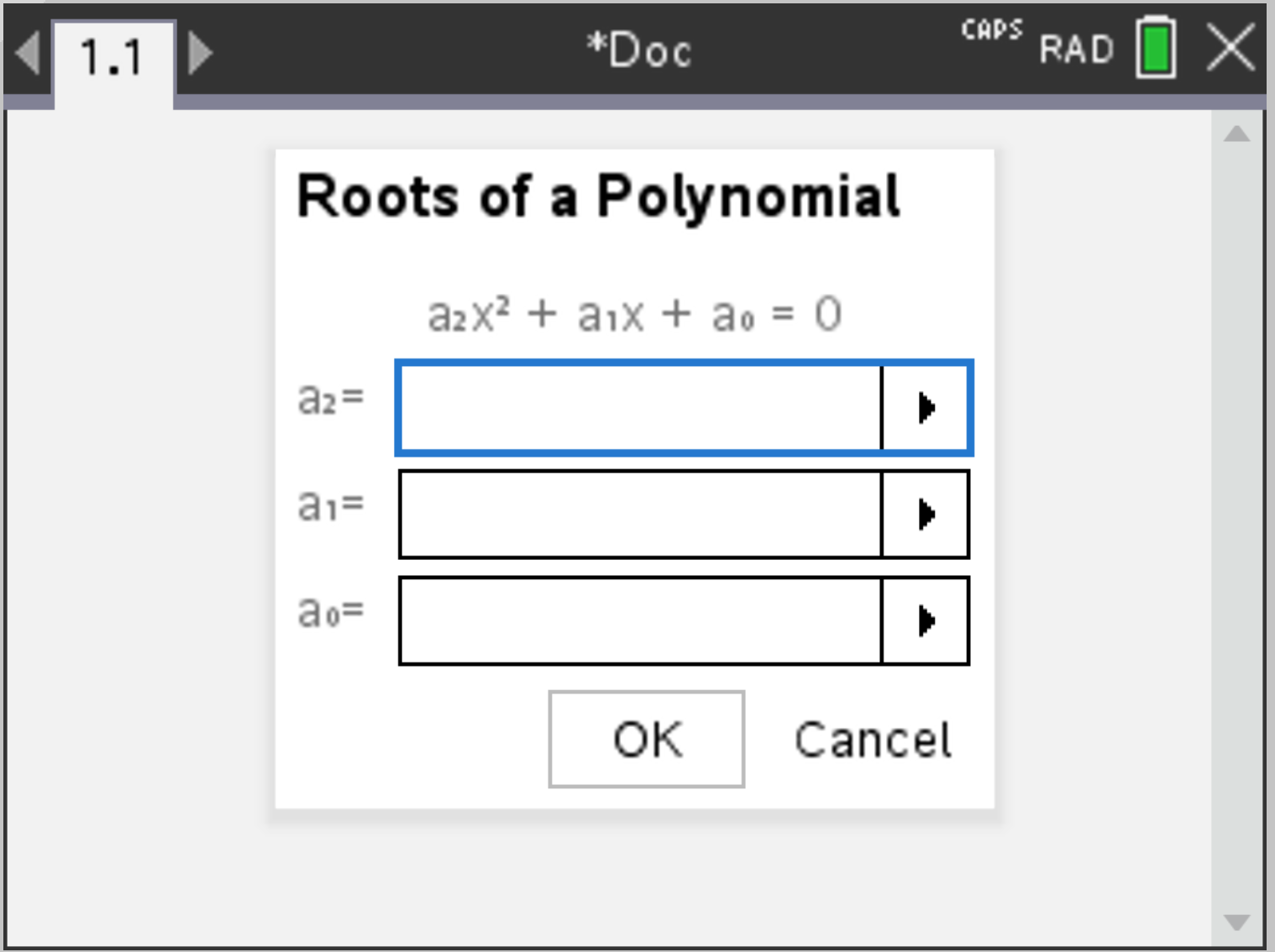
- The box Roots of a Polynomial opens. It shows the form of the equation, for example \(a_2x^2 + a_1x + a_0 = 0\). Type the coefficients from the highest power down. Type \(0\) for a missing power. Choose OK.
- The real roots appear as a list, for example \(\{-2.15831, 1., 1.15831\}\). An empty list \(\{\;\}\) means there are no real roots.
(With Roots set to Complex, the GDC also shows non-real roots. You need this only at HL.)
Example 1 Solve the equation \(2x^3 + 5 = 7x\).
In the form \(p(x) = 0\): \(\;2x^3 + 0x^2 - 7x + 5 = 0\).
Use Find Roots of Polynomial with degree \(3\) and coefficients \(2\), \(0\), \(-7\), \(5\). The GDC gives
\[ x = -2.16, \qquad x = 1, \qquad x = 1.16 . \]
These are correct to 3 significant figures (s.f.). (The GDC values are \(-2.158\,31\ldots\) and \(1.158\,31\ldots\))
Check \(x = 1\): \(\;2(1)^3 + 5 = 7 = 7(1)\) ✓.
Example 2 Solve \(3x^2 - 4x - 9 = 0\). Give your answers correct to 3 s.f.
Find Roots of Polynomial, degree \(2\), coefficients \(3\), \(-4\), \(-9\):
\[ x = -1.19 \quad \text{or} \quad x = 2.52 . \]
(The GDC values are \(-1.189\,25\ldots\) and \(2.522\,58\ldots\))
Solving with a graph
The graph method shows where the roots are and how many there are. Draw \(y = p(x)\) and find each zero.
Zeros (Graphs page)
- Enter \(f_1(x) = p(x)\).
- If needed, Menu → Window / Zoom → Window Settings so that every \(x\)-intercept can be seen.
- Menu → Analyze Graph → Zero.
- Click a point to the left of one zero (lower bound), then a point to the right of it (upper bound). Make sure only one zero is between the two points.
- The zero is labelled on the graph. Repeat for each zero.
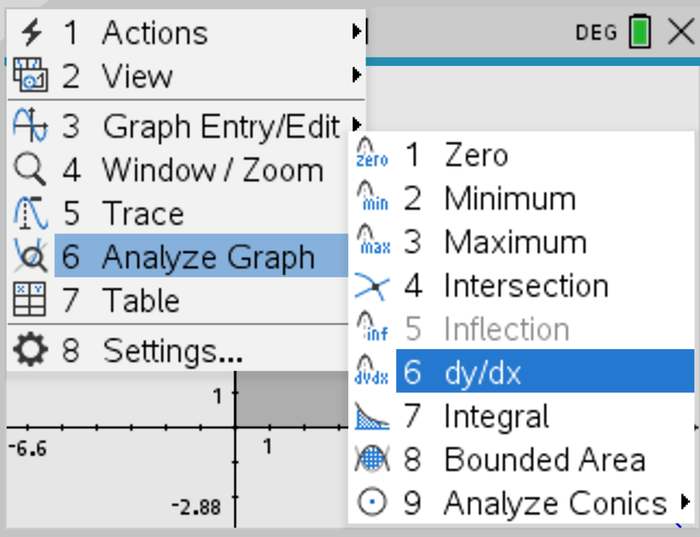
Intersection — you do not need to rearrange. For \(2x^3 + 5 = 7x\), enter \(f_1(x) = 2x^3 + 5\) and \(f_2(x) = 7x\), then use Menu → Analyze Graph → Intersection for each point where the graphs meet.
nSolve (Calculator page) — Menu → Algebra → Numerical Solve gives one root. Type a guess to choose which root: nSolve(2x^3+5=7x, x=1.2) gives \(1.158\,31\ldots\)
Example 3 (a) Sketch the graph of \(y = x^4 - 5x^2 + 2x + 1\) for \(-3 \le x \le 3\).
(b) Hence write down the number of real roots of \(x^4 - 5x^2 + 2x + 1 = 0\), and solve the equation.
(a)
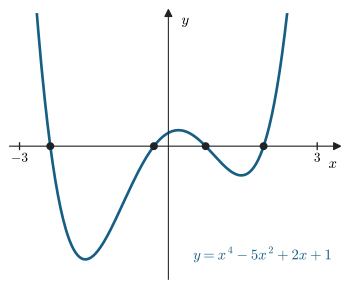
(b) The graph meets the \(x\)-axis four times, so there are \(4\) real roots. Menu → Analyze Graph → Zero (four times) gives
\[ x = -2.38, \qquad x = -0.291, \qquad x = 0.751, \qquad x = 1.92 . \]
(Find Roots of Polynomial with coefficients \(1\), \(0\), \(-5\), \(2\), \(1\) gives the same values.)
Example 4 Show that the equation \(x^2 + 2x + 5 = 0\) has no real roots.
Find Roots of Polynomial (degree \(2\), coefficients \(1\), \(2\), \(5\), Real) gives an empty list.
The graph agrees: \(y = x^2 + 2x + 5 = (x + 1)^2 + 4\), so \(y \ge 4\) for every \(x\). The graph never meets the \(x\)-axis, so there are no real roots.
Polynomial equations in context
In a real problem, the variable usually has a domain: for example, a length must be positive. Find all the roots, then reject the roots that do not make sense in the context.
Example 5 An open box is made from a rectangular sheet of card, \(30\) cm by \(20\) cm. A square of side \(x\) cm is cut from each corner, and the sides are folded up. The volume of the box is
\[ \begin{aligned} V &= x(30 - 2x)(20 - 2x) \\ &= 4x^3 - 100x^2 + 600x \end{aligned} \]
(a) Explain why \(0 < x < 10\).
(b) Find the possible values of \(x\) for which the volume is \(900 \text{ cm}^3\).
(a) \(x\) is a length, so \(x > 0\). The width of the box is \(20 - 2x\), which must be positive, so \(x < 10\).
(b) In the form \(p(x) = 0\): \(\;4x^3 - 100x^2 + 600x - 900 = 0\).
Find Roots of Polynomial (coefficients \(4\), \(-100\), \(600\), \(-900\)) gives
\[ x = 2.30, \qquad x = 5.78, \qquad x = 16.9 . \]
\(x = 16.9\) is not in \(0 < x < 10\), so we reject it (the width \(20 - 2x\) would be negative).
The square cut from each corner has side \(2.30\) cm or \(5.78\) cm. Both give a box with volume \(900 \text{ cm}^3\).
Example 6 A company’s profit \(P\), in thousands of dollars, from selling \(x\) thousand items is modelled by
\[ P(x) = -x^3 + 12x^2 - 20x - 30, \qquad 0 \le x \le 11 . \]
(a) Find the values of \(x\) for which \(P(x) = 0\).
(b) Interpret your answer to (a) in context.
(a) Find Roots of Polynomial (coefficients \(-1\), \(12\), \(-20\), \(-30\)) gives \(x = -0.935\), \(x = 3.35\) and \(x = 9.59\).
\(x = -0.935\) is not in the domain \(0 \le x \le 11\), so we reject it. The answers are \(x = 3.35\) and \(x = 9.59\).
(b) These are the break-even points. The company makes a profit when it sells between about \(3350\) and \(9590\) items, and a loss when it sells fewer than \(3350\) or more than \(9590\) items. (Check: \(P(5) = 45 > 0\).)
Common errors
| ✗ Wrong | ✓ Right | Why |
|---|---|---|
| \(2x^3 - 7x + 5\) entered as \(2\), \(-7\), \(5\) | \(2\), \(0\), \(-7\), \(5\) | The missing \(x^2\) term has coefficient \(0\). |
| Entering \(2x^3 + 5 = 7x\) as \(2\), \(0\), \(7\), \(5\) | First rearrange to \(2x^3 - 7x + 5 = 0\) | Find Roots solves \(p(x) = 0\) only. |
| “The equation has no solution.” | “It has no real roots.” | It has complex roots (HL). |
| Giving all three roots in Example 5 | Reject \(x = 16.9\) | The answer must fit the context. |
| Zero tool with two roots between the bounds | Choose bounds around one root | Otherwise the GDC may give the wrong root. |
Exercises
1 Solve \(x^3 - 6x^2 + 11x - 6 = 0\).
Find Roots of Polynomial (coefficients \(1\), \(-6\), \(11\), \(-6\)): \(x = 1\), \(x = 2\), \(x = 3\).
2 Solve \(2x^2 + 3x - 7 = 0\), giving your answers to 3 s.f.
GDC (coefficients \(2\), \(3\), \(-7\)): \(x = -2.77\) or \(x = 1.27\).
3 Solve \(x^3 = 3x + 1\).
In the form \(p(x) = 0\): \(\;x^3 + 0x^2 - 3x - 1 = 0\). GDC (coefficients \(1\), \(0\), \(-3\), \(-1\)):
\(x = -1.53\), \(\;x = -0.347\), \(\;x = 1.88\).
4 Solve \(x^4 - 4x^2 + x + 1 = 0\).
GDC (coefficients \(1\), \(0\), \(-4\), \(1\), \(1\)): \(x = -2.06\), \(\;x = -0.396\), \(\;x = 0.694\), \(\;x = 1.76\).
5 (a) Show that the equation \((x + 1)(x - 2)^2 = 5\) can be written as \(x^3 - 3x^2 - 1 = 0\).
(b) Hence solve the equation.
(a)
\[ \begin{aligned} (x + 1)(x - 2)^2 &= (x + 1)(x^2 - 4x + 4) \\ &= x^3 - 4x^2 + 4x + x^2 - 4x + 4 \\ &= x^3 - 3x^2 + 4 \end{aligned} \]
So \(x^3 - 3x^2 + 4 = 5\), that is \(x^3 - 3x^2 - 1 = 0\).
(b) GDC (coefficients \(1\), \(-3\), \(0\), \(-1\)): there is only one real root, \(x = 3.10\).
6 Use a graph to find the number of real roots of \(x^3 + x + 4 = 0\). Then solve the equation.
The graph of \(y = x^3 + x + 4\) is always increasing, so it meets the \(x\)-axis only once: there is \(1\) real root.
Zero (or Find Roots of Polynomial): \(x = -1.38\).
7 A rectangular garden is \(5\) m longer than it is wide. Its area is \(84 \text{ m}^2\).
(a) Let the width be \(w\) m. Show that \(w^2 + 5w - 84 = 0\).
(b) Find the length and the width of the garden.
(a) The length is \(w + 5\), so \(w(w + 5) = 84\), that is \(w^2 + 5w - 84 = 0\).
(b) GDC: \(w = -12\) or \(w = 7\). A width cannot be negative, so \(w = 7\). The garden is \(7\) m wide and \(12\) m long.
8 A box has a square base of side \(x\) cm. Its height is \(3\) cm more than the side of the base. The volume of the box is \(250 \text{ cm}^3\).
(a) Show that \(x^3 + 3x^2 - 250 = 0\).
(b) Find the dimensions of the box.
(a) Volume \(= x^2(x + 3) = x^3 + 3x^2 = 250\), so \(x^3 + 3x^2 - 250 = 0\).
(b) GDC (coefficients \(1\), \(3\), \(0\), \(-250\)): the only real root is \(x = 5.44\) (GDC: \(5.441\,89\ldots\)).
The base is \(5.44\) cm by \(5.44\) cm and the height is \(8.44\) cm.
9 The height of a ball, \(h\) metres, \(t\) seconds after it is kicked is \(h = -4.9t^2 + 12t + 1.8\).
(a) Find the times when the ball is \(6\) m above the ground.
(b) Explain why there are two answers.
(a) \(-4.9t^2 + 12t + 1.8 = 6\), so \(-4.9t^2 + 12t - 4.2 = 0\).
GDC (coefficients \(-4.9\), \(12\), \(-4.2\)): \(t = 0.423\) s or \(t = 2.03\) s.
(b) The ball passes the height of \(6\) m twice: once on the way up, and once on the way down.
10 The temperature \(T\) °C in a greenhouse, \(t\) hours after 6 am, is modelled by
\[ T = 0.05t^3 - 1.1t^2 + 6t + 12, \qquad 0 \le t \le 14 . \]
(a) Find the values of \(t\) for which \(T = 20\).
(b) Hence write down the times of day when the temperature is \(20\) °C.
(a) \(0.05t^3 - 1.1t^2 + 6t - 8 = 0\). GDC: \(t = 2\), \(t = 5.53\) or \(t = 14.5\).
\(t = 14.5\) is not in the domain \(0 \le t \le 14\), so we reject it. So \(t = 2\) or \(t = 5.53\) (GDC: \(5.527\,86\ldots\)).
(b) \(2\) hours after 6 am is 8:00 am. \(\;5.527\,86\) hours is \(5\) hours \(31.7\) minutes, so about 11:32 am.