1.1 Standard Form
SL 1.1
- what standard form \(a \times 10^k\) is, and why it is useful for very large and very small numbers
- how to change between ordinary numbers and standard form, and how to compare numbers in standard form
- how to multiply, divide, add and subtract numbers in standard form
- how to read calculator notation such as
9.46E12, and why you must write it as \(9.46 \times 10^{12}\)
Scientists, engineers and economists often work with numbers that are very large (the distance to a star) or very small (the mass of a bacterium). Written out in full, these numbers have many zeros, and it is easy to make mistakes. Standard form solves this problem.
Writing numbers in standard form
Standard form Not in the formula booklet
A number is in standard form when it is written as
\[ a \times 10^k , \qquad 1 \le a < 10, \quad k \in \mathbb{Z} . \]
- \(a\): a number from \(1\) up to, but not including, \(10\)
- \(k\): an integer (a whole number, positive, negative or zero)
Standard form is also called scientific notation. To write a number in standard form:
- Place the decimal point after the first non-zero digit. This gives \(a\).
- Count how many places the decimal point has moved. This gives the size of \(k\).
- A number of \(10\) or more has a positive \(k\). A number less than \(1\) has a negative \(k\). A number from \(1\) to \(10\) has \(k = 0\).
| Ordinary number | Standard form | Why |
|---|---|---|
| \(47\,300\,000\) | \(4.73 \times 10^{7}\) | the point moves 7 places to the left |
| \(0.000\,058\) | \(5.8 \times 10^{-5}\) | the point moves 5 places to the right |
| \(6.2\) | \(6.2 \times 10^{0}\) | \(10^0 = 1\) |
Example 1 Write each number in standard form.
(a) The average distance from the Sun to Neptune is about \(4\,500\,000\,000\) km.
(b) The diameter of a red blood cell is about \(0.000\,007\,8\) m.
(c) \(36.5 \times 10^{4}\)
(d) \(0.42 \times 10^{-3}\)
(a) The point moves 9 places to the left: \(4.5 \times 10^{9}\) km.
(b) The point moves 6 places to the right: \(7.8 \times 10^{-6}\) m.
(c) \(36.5\) is not between \(1\) and \(10\), so this is not yet standard form. Write \(36.5 = 3.65 \times 10^{1}\):
\[ 36.5 \times 10^{4} = 3.65 \times 10^{1} \times 10^{4} = 3.65 \times 10^{5} . \]
(d) \(0.42 = 4.2 \times 10^{-1}\), so
\[ 0.42 \times 10^{-3} = 4.2 \times 10^{-1} \times 10^{-3} = 4.2 \times 10^{-4} . \]
To compare numbers in standard form, look at the powers of ten first. The larger power of ten gives the larger number (for positive numbers). If the powers are the same, compare the values of \(a\).
Example 2 (a) Write \(3.08 \times 10^{6}\) and \(9.1 \times 10^{-4}\) as ordinary numbers.
(b) Write these lengths (in metres) in order of size, smallest first:
\[ 2.4 \times 10^{-3}, \quad 9.9 \times 10^{-4}, \quad 2.04 \times 10^{-3}, \quad 1.1 \times 10^{-2} \]
(a) \(3.08 \times 10^{6} = 3\,080\,000\) and \(9.1 \times 10^{-4} = 0.000\,91\).
(b) The smallest power of ten is \(10^{-4}\), so \(9.9 \times 10^{-4}\) is the smallest. Two numbers have \(10^{-3}\); compare \(2.04 < 2.4\). The largest power is \(10^{-2}\).
\[ 9.9 \times 10^{-4} < 2.04 \times 10^{-3} < 2.4 \times 10^{-3} < 1.1 \times 10^{-2} \]
Calculating in standard form
To multiply or divide, work with the numbers \(a\) and the powers of ten separately. Then use the laws of exponents for the powers of ten. At the end, make sure the answer is in standard form.
Multiplying and dividing in standard form Not in the formula booklet
\[ (a \times 10^{m}) \times (b \times 10^{n}) = (a \times b) \times 10^{m + n} \]
\[ (a \times 10^{m}) \div (b \times 10^{n}) = (a \div b) \times 10^{m - n} \]
- \(a\), \(b\): the number parts of the two numbers
- \(m\), \(n\): the integer powers of ten
To add or subtract, first write both numbers with the same power of ten (or change them to ordinary numbers). Then add or subtract the number parts.
Example 3 Without a calculator, work out each answer. Give it in standard form.
(a) \((4 \times 10^{5}) \times (7 \times 10^{-2})\)
(b) \((6.3 \times 10^{8}) \div (9 \times 10^{3})\)
(c) \(5.2 \times 10^{6} + 4.9 \times 10^{5}\)
(a)
\[ \begin{aligned} (4 \times 10^{5}) \times (7 \times 10^{-2}) &= 28 \times 10^{3} \\ &= 2.8 \times 10^{1} \times 10^{3} \\ &= 2.8 \times 10^{4} \end{aligned} \]
(b)
\[ \begin{aligned} (6.3 \times 10^{8}) \div (9 \times 10^{3}) &= 0.7 \times 10^{5} \\ &= 7 \times 10^{-1} \times 10^{5} \\ &= 7 \times 10^{4} \end{aligned} \]
(c) Write \(4.9 \times 10^{5} = 0.49 \times 10^{6}\), so both numbers have \(10^{6}\):
\[ \begin{aligned} 5.2 \times 10^{6} + 0.49 \times 10^{6} &= (5.2 + 0.49) \times 10^{6} \\ &= 5.69 \times 10^{6} \end{aligned} \]
Standard form on the GDC
A graphic display calculator (GDC) shows very large and very small answers in calculator notation. For example, the TI-Nspire CX II shows
\[ \texttt{9.46E12} \quad \text{for} \quad 9.46 \times 10^{12} . \]
The letter E means “\(\times 10\) to the power”. This notation is not acceptable in an answer.
Calculator notation in answers
Never copy E notation from the screen. Always write \(a \times 10^{k}\): 5.2E30 must be written \(5.2 \times 10^{30}\), and 6.4E-7 must be written \(6.4 \times 10^{-7}\).
Typing a number in standard form (Calculator page)
- Type the number part, for example
2.998. - Press the EE key. The screen shows
E. - Type the power, for example
5. The screen shows2.998E5.
You can also type 2.998*10^5. In a division, put this in brackets: 1.496E8/(2.998*10^5). Without brackets, the GDC divides by \(2.998\) and then multiplies by \(10^5\).
Showing every answer in standard form
- Press doc, then choose Settings & Status → Document Settings….
- Change Exponential Format from Normal to Scientific.
- Choose OK. Now every answer appears as \(a\)
E\(k\).
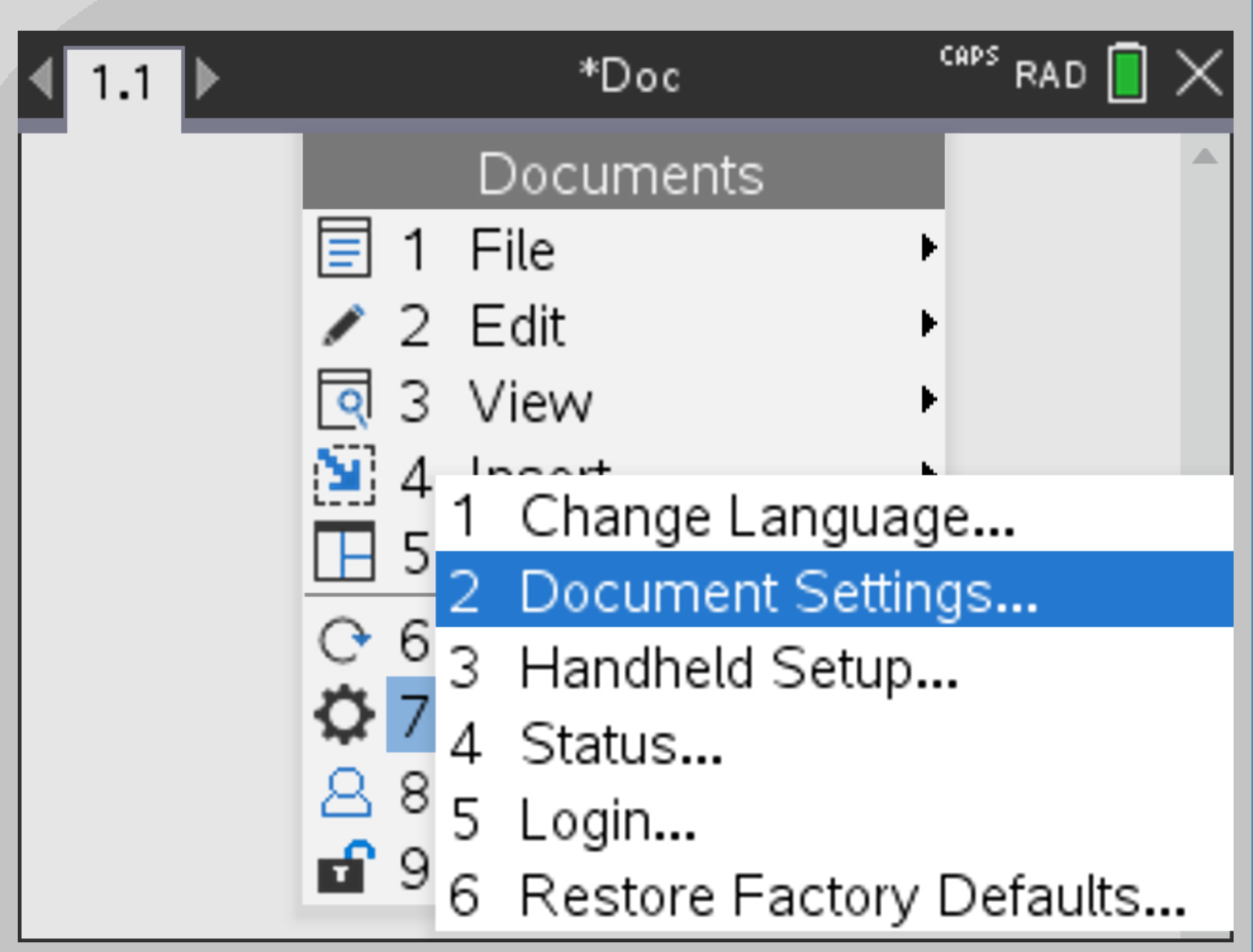
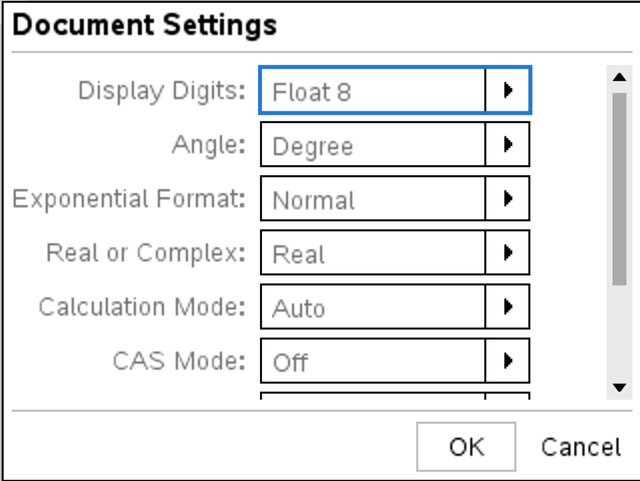
In Normal format, the GDC changes to E notation by itself when a number is very large or very small.
Example 4 Light travels at \(2.998 \times 10^{5}\) km per second. A light-year is the distance that light travels in one year. Use \(1 \text{ year} = 365.25\) days.
(a) Find the length of a light-year in kilometres. Give your answer in standard form.
(b) The star Proxima Centauri is \(4.02 \times 10^{13}\) km from the Earth. Find this distance in light-years.
(c) Interpret your answer to (b) in terms of the light that we see from the star.
(a) The number of seconds in one year is \(365.25 \times 24 \times 60 \times 60\). So
\[ \begin{aligned} \text{light-year} &= 2.998 \times 10^{5} \times 365.25 \times 24 \times 3600 \\ &= 9.460\,968\,48 \times 10^{12} \end{aligned} \]
The GDC shows this in E notation (9.46096…E12). The answer is \(9.46 \times 10^{12}\) km, correct to 3 significant figures (s.f.).
(b) Use the unrounded value from (a):
\[ \frac{4.02 \times 10^{13}}{9.46096848 \times 10^{12}} = 4.249\ldots \approx 4.25 \text{ light-years.} \]
(c) The light that we see from Proxima Centauri left the star about \(4.25\) years ago. We see the star as it was more than four years ago.
Example 5 The mass of one bacterium of a certain type is about \(9.5 \times 10^{-13}\) g. A sample of these bacteria has a total mass of \(0.002\) g.
(a) Estimate the number of bacteria in the sample. Give your answer in standard form.
(b) Explain why your answer is only an estimate.
(a)
\[ \frac{0.002}{9.5 \times 10^{-13}} = 2\,105\,263\,158\ldots \approx 2.11 \times 10^{9} . \]
The GDC shows 2.10526…E9, which we write as \(2.11 \times 10^{9}\) bacteria (3 s.f.).
(b) The mass of one bacterium is only about \(9.5 \times 10^{-13}\) g. Real bacteria have different masses, so the number in the sample is not known exactly. About two thousand million is a sensible estimate.
Common errors
| ✗ Wrong | ✓ Right | Why |
|---|---|---|
| \(34 \times 10^{5}\) | \(3.4 \times 10^{6}\) | In standard form \(1 \le a < 10\). |
| \(0.000\,72 = 7.2 \times 10^{4}\) | \(7.2 \times 10^{-4}\) | A number less than \(1\) has a negative power of ten. |
Answer: 9.46E12 |
\(9.46 \times 10^{12}\) | Calculator notation is not acceptable. |
| \(3 \times 10^{4} + 2 \times 10^{3} = 5 \times 10^{7}\) | \(3.2 \times 10^{4}\) | Add only when the powers of ten are the same. |
Typing 1.496E8/2.998*10^5 |
1.496E8/(2.998*10^5) or use EE |
Without brackets the GDC multiplies by \(10^5\). |
Exercises
1 Write each number in standard form.
(a) \(602\,000\)
(b) \(0.000\,34\)
(c) \(18.4 \times 10^{6}\)
(d) \(0.075 \times 10^{-2}\)
(a) \(6.02 \times 10^{5}\)
(b) \(3.4 \times 10^{-4}\)
(c) \(18.4 = 1.84 \times 10^{1}\), so \(1.84 \times 10^{7}\).
(d) \(0.075 = 7.5 \times 10^{-2}\), so \(7.5 \times 10^{-2} \times 10^{-2} = 7.5 \times 10^{-4}\).
2 Write each number as an ordinary number.
(a) \(7.05 \times 10^{4}\)
(b) \(3.3 \times 10^{-5}\)
(a) \(70\,500\)
(b) \(0.000\,033\)
3 Without a calculator, work out each answer. Give it in standard form.
(a) \((5 \times 10^{3}) \times (8 \times 10^{6})\)
(b) \((1.2 \times 10^{-3}) \div (4 \times 10^{-7})\)
(c) \(6.1 \times 10^{-3} - 4 \times 10^{-4}\)
(a) \(40 \times 10^{9} = 4 \times 10^{10}\).
(b) \(0.3 \times 10^{4} = 3 \times 10^{3}\).
(c) \(4 \times 10^{-4} = 0.4 \times 10^{-3}\), so \((6.1 - 0.4) \times 10^{-3} = 5.7 \times 10^{-3}\).
4 Write these numbers in order of size, smallest first.
\[ 3.1 \times 10^{-2}, \quad 0.0029, \quad 3.01 \times 10^{-3}, \quad 2.9 \times 10^{-2} \]
\(0.0029 = 2.9 \times 10^{-3}\). Compare powers of ten first, then the number parts:
\[ 0.0029 < 3.01 \times 10^{-3} < 2.9 \times 10^{-2} < 3.1 \times 10^{-2} \]
5 A GDC screen shows 6.4E-7.
(a) Write this number in the form required in an answer.
(b) Write it as an ordinary number.
(a) \(6.4 \times 10^{-7}\)
(b) \(0.000\,000\,64\)
6 The mass of the Earth is \(5.97 \times 10^{24}\) kg. The mass of the Moon is \(7.35 \times 10^{22}\) kg.
(a) How many times heavier than the Moon is the Earth?
(b) Find the total mass of the Earth and the Moon. Give your answer in standard form.
(a) \(\dfrac{5.97 \times 10^{24}}{7.35 \times 10^{22}} = 81.22\ldots\) The Earth is about \(81.2\) times heavier.
(b)
\[ \begin{aligned} 5.97 \times 10^{24} + 0.0735 \times 10^{24} &= 6.0435 \times 10^{24} \\ &\approx 6.04 \times 10^{24}\text{ kg} \end{aligned} \]
7 A hard drive can store \(2 \times 10^{12}\) bytes. One photo uses \(4.5 \times 10^{6}\) bytes.
(a) Find the greatest number of photos that the hard drive can store.
(b) Write your answer to (a) in standard form, correct to 3 s.f.
(a) \(\dfrac{2 \times 10^{12}}{4.5 \times 10^{6}} = 444\,444.4\ldots\) Only complete photos can be stored, so we round down: \(444\,444\) photos.
(b) \(4.44 \times 10^{5}\) photos.
8 The mass of one water molecule is \(2.99 \times 10^{-23}\) g. One litre of water has a mass of \(1000\) g. Find the number of water molecules in one litre of water.
\[ \frac{1000}{2.99 \times 10^{-23}} = 3.344\ldots \times 10^{25} \approx 3.34 \times 10^{25} \text{ molecules.} \]
(The GDC shows 3.34448…E25.)
9 In one year, the total value of goods and services produced in a country (its GDP) was \(\$3.86 \times 10^{12}\). The population was \(8.42 \times 10^{7}\).
(a) Find the GDP per person, correct to the nearest cent.
(b) Write your answer to (a) in standard form, correct to 3 s.f.
(c) Does every person in the country produce this amount? Explain briefly.
(a) \(\dfrac{3.86 \times 10^{12}}{8.42 \times 10^{7}} = 45\,843.230\ldots \approx \$45\,843.23\).
(b) \(\$4.58 \times 10^{4}\).
(c) No. This is an average (mean) value. Some people produce much more, and some (for example children) produce much less.
10 A virus has a diameter of \(1.2 \times 10^{-7}\) m.
(a) How many of these viruses, placed side by side, would make a line \(1\) mm long?
(b) A student types 1E-3/1.2*10^-7 into a GDC and gets 8.33333E-11. Explain the mistake.
(a) \(1 \text{ mm} = 1 \times 10^{-3}\) m. \(\;\dfrac{1 \times 10^{-3}}{1.2 \times 10^{-7}} = 8333.3\ldots\), so about \(8333\) viruses (whole viruses only).
(b) Without brackets, the GDC works out \(\dfrac{1 \times 10^{-3}}{1.2}\) and then multiplies by \(10^{-7}\). The student should type 1E-3/(1.2*10^-7) or 1E-3/1.2E-7. Also, a tiny answer like \(8.33 \times 10^{-11}\) viruses is clearly not reasonable.