1.4 Solving Systems of Linear Equations with a GDC
SL 1.8
- what a system of linear equations is, and what its solution means
- how to set up a system of equations from a real-life situation
- how to solve systems with two or three unknowns on the TI-Nspire CX II
- how to find the quadratic \(y = ax^2 + bx + c\) that passes through three given points
- how to check a solution and interpret it in context
Systems of linear equations
An equation is linear when each unknown appears only to the power \(1\), with no products of unknowns and no unknowns in a denominator. For example, \(2c + 3m = 19.70\) is linear, but \(xy = 6\) and \(x^2 + y = 4\) are not.
A system of linear equations is a set of linear equations with the same unknowns. A solution of the system is a set of values that makes every equation true at the same time.
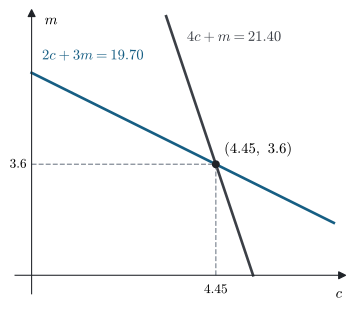
For two unknowns, each equation is a straight line. The solution is the point where the lines intersect.
Systems in the IB examination
- You may use any method to solve a system: no particular method is required.
- The system will always have one (unique) solution.
- You need as many equations as unknowns: 2 equations for 2 unknowns, 3 equations for 3 unknowns.
Solving a problem with a system of equations
- Define the unknowns, with units (for example “\(c\) = the price of one coffee in dollars”).
- Write one equation for each piece of information. Use the same units everywhere.
- Solve the system with your graphic display calculator (GDC).
- Check the values in the original information.
- Answer the question in context, with units.
Example 1 At a café, \(2\) coffees and \(3\) muffins cost \(\$19.70\). \(4\) coffees and \(1\) muffin cost \(\$21.40\). Find the price of one coffee and the price of one muffin.
Let \(c\) be the price of a coffee and \(m\) the price of a muffin, in dollars.
\[ \begin{aligned} 2c + 3m &= 19.70 && {\color{#165E83}\text{(1)}} \\ 4c + m &= 21.40 && {\color{#165E83}\text{(2)}} \end{aligned} \]
With the GDC (see the box below): \(c = 4.45\), \(m = 3.6\).
By hand (to see the idea): multiply (2) by \(3\) to get \(12c + 3m = 64.20\). Subtract (1):
\[ 10c = 44.50 \;\Longrightarrow\; c = 4.45 . \]
Then from (2): \(m = 21.40 - 4 \times 4.45 = 3.60\).
Check in (1): \(2 \times 4.45 + 3 \times 3.60 = 8.90 + 10.80 = 19.70\) ✓.
A coffee costs \(\$4.45\) and a muffin costs \(\$3.60\).
On a Calculator page:
Menu → Algebra → Solve System of Equations → Solve System of Linear Equations.
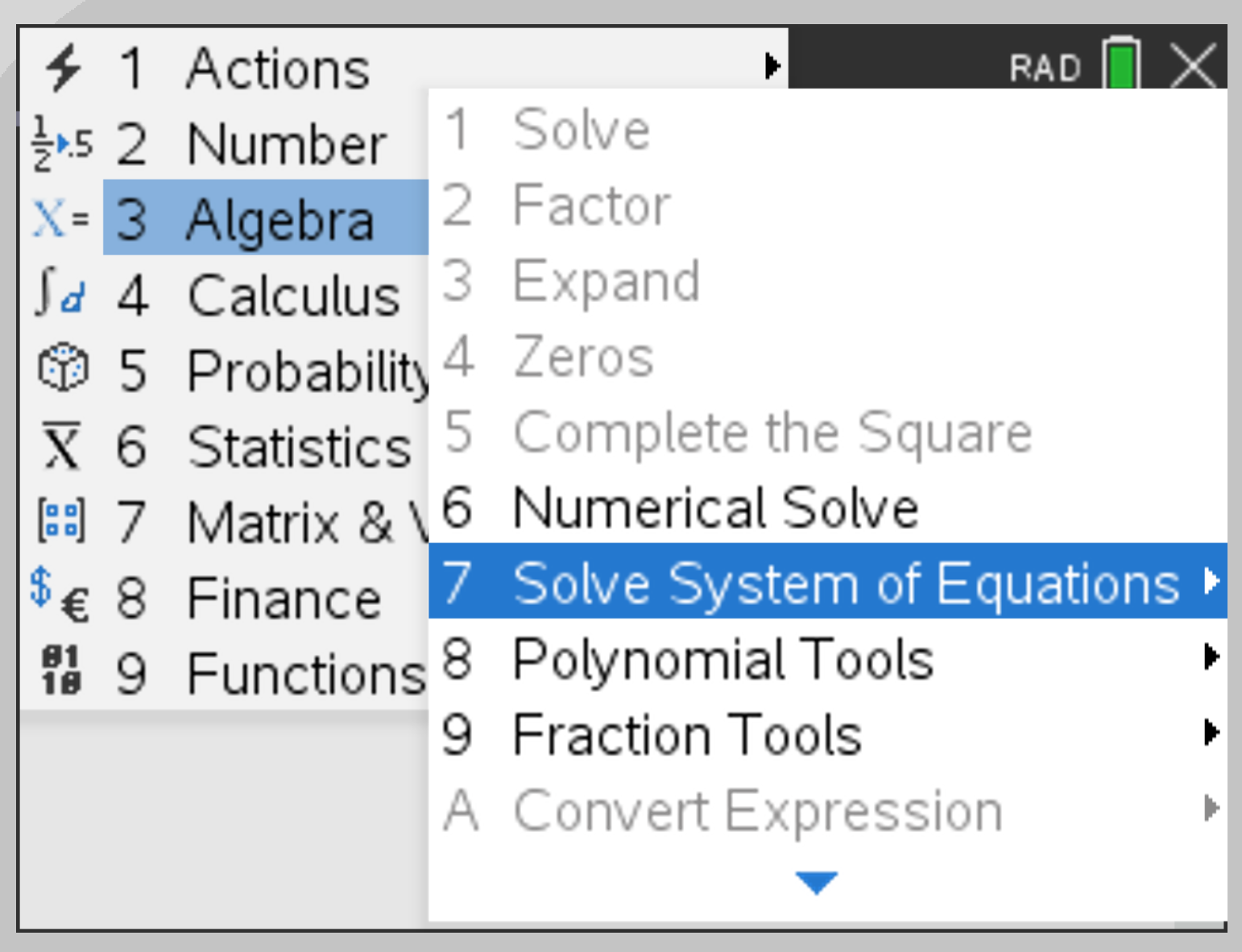
Menu → Algebra → Solve System of Equations In the box, set Number of Equations to \(2\) (or \(3\)).
In Variables, type the unknowns separated by commas, for example
c,m. Choose OK.A
linSolvetemplate appears. Type one equation in each line, for example2c+3m=19.70and4c+m=21.40.Press enter. The answer is a list in the same order as the variables: \(\{4.45, 3.6\}\) means \(c = 4.45\), \(m = 3.6\).
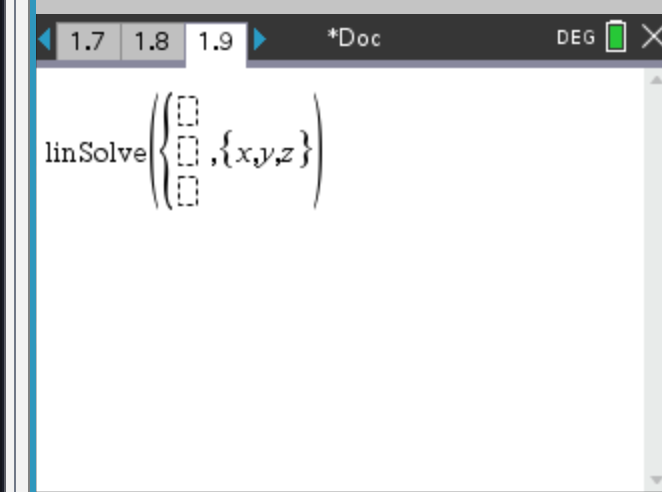
linSolve template for three equations in \(x\), \(y\) and \(z\).The equations do not need to be rearranged first: you can type, for example, t=2h. Type multiplication signs between letters (2*c*m is different from 2cm, which the GDC reads as one variable named cm).
Systems with three unknowns
With three unknowns, you need three equations. Solving them by hand takes a long time, so in the examination you should use the GDC.
Example 2 Solve the system of equations
\[ \begin{aligned} 3x - y + 2z &= 13 \\ x + 4y - z &= -5 \\ 2x + y + 3z &= 12 \end{aligned} \]
Use Solve System of Linear Equations with \(3\) equations and variables x,y,z. The GDC gives \(\{2, -1, 3\}\), so
\[ x = 2, \qquad y = -1, \qquad z = 3 . \]
Check in the second equation: \(2 + 4(-1) - 3 = -5\) ✓.
Example 3 A concert hall sells three types of ticket: standing, seated and VIP. The prices are the same every night.
| Night | Standing | Seated | VIP | Total income |
|---|---|---|---|---|
| 1 | \(300\) | \(500\) | \(40\) | \(\$53\,500\) |
| 2 | \(420\) | \(380\) | \(55\) | \(\$52\,990\) |
| 3 | \(250\) | \(520\) | \(70\) | \(\$57\,110\) |
(a) Write down a system of equations for the prices.
(b) Find the price of each type of ticket.
(c) On night 4, the hall sells \(350\) standing, \(450\) seated and \(60\) VIP tickets. Find the income on night 4.
(a) Let \(s\), \(t\) and \(v\) be the prices (in dollars) of a standing, a seated and a VIP ticket.
\[ \begin{aligned} 300s + 500t + 40v &= 53\,500 \\ 420s + 380t + 55v &= 52\,990 \\ 250s + 520t + 70v &= 57\,110 \end{aligned} \]
(b) The GDC gives \(s = 45\), \(t = 68\), \(v = 150\). A standing ticket costs \(\$45\), a seated ticket \(\$68\) and a VIP ticket \(\$150\).
(c)
\[ \begin{aligned} 350 \times 45 + 450 \times 68 + 60 \times 150 &= 15\,750 + 30\,600 + 9000 \\ &= \$55\,350 \end{aligned} \]
Fitting a quadratic through three points
A quadratic model \(y = ax^2 + bx + c\) has three unknown coefficients \(a\), \(b\) and \(c\). If we know three points on the graph, each point gives one linear equation in \(a\), \(b\) and \(c\). Then we can solve the system. (Quadratic models are studied in Unit 10.)
A quadratic through three points Not in the formula booklet
Substitute each point \((x_i, y_i)\) into \(y = ax^2 + bx + c\):
\[ a x_i^2 + b x_i + c = y_i , \qquad i = 1, 2, 3 . \]
This gives three linear equations in \(a\), \(b\) and \(c\).
- \((x_i, y_i)\): the coordinates of the \(i\)th point
- \(a\), \(b\), \(c\): the coefficients of the quadratic (the unknowns of the system)
Example 4 A ball is thrown upwards. Its height \(h\) metres after \(t\) seconds is modelled by \(h = at^2 + bt + c\). The ball is \(14.2\) m high after \(1\) s, \(17.2\) m high after \(2\) s and \(10.2\) m high after \(3\) s.
(a) Write down three equations in \(a\), \(b\) and \(c\).
(b) Find \(a\), \(b\) and \(c\).
(c) Write down the height from which the ball was thrown.
(a) Substitute \((1, 14.2)\), \((2, 17.2)\) and \((3, 10.2)\):
\[ \begin{aligned} a + b + c &= 14.2 \\ 4a + 2b + c &= 17.2 \\ 9a + 3b + c &= 10.2 \end{aligned} \]
(b) The GDC gives \(a = -5\), \(b = 18\), \(c = 1.2\). So \(h = -5t^2 + 18t + 1.2\).
(c) The ball was thrown at \(t = 0\): \(h = c = 1.2\) m. It was thrown from a height of \(1.2\) m.
Example 5 A food company mixes three cereals A, B and C to make \(1000\) g of a breakfast mix. The table shows the protein and fibre in each gram of cereal.
| A | B | C | |
|---|---|---|---|
| Protein (g per g) | \(0.14\) | \(0.08\) | \(0.12\) |
| Fibre (g per g) | \(0.06\) | \(0.12\) | \(0.09\) |
The mix must contain \(118\) g of protein and \(85.5\) g of fibre.
(a) Find how many grams of each cereal are used.
(b) Explain why the answer must be checked in context.
(a) Let \(a\), \(b\) and \(c\) be the masses (in grams) of cereals A, B and C.
\[ \begin{aligned} a + b + c &= 1000 && {\color{#165E83}\text{total mass}} \\ 0.14a + 0.08b + 0.12c &= 118 && {\color{#165E83}\text{protein}} \\ 0.06a + 0.12b + 0.09c &= 85.5 && {\color{#165E83}\text{fibre}} \end{aligned} \]
The GDC gives \(a = 400\), \(b = 250\), \(c = 350\). The mix uses \(400\) g of A, \(250\) g of B and \(350\) g of C.
(b) Masses cannot be negative. Here all three values are positive, so the mix is possible. If the GDC gave a negative value, the company could not make this mix from these three cereals.
Common errors
| ✗ Wrong | ✓ Right | Why |
|---|---|---|
| Prices in cents in one equation and in dollars in another | Use the same units everywhere | Otherwise the equations do not describe the same unknowns. |
| Reading \(\{4.45, 3.6\}\) as \(m = 4.45\) | \(c = 4.45\), \(m = 3.6\) | The list is in the order of the variables you typed. |
| Point \((2, 17.2)\) gives \(2a + 2b + c = 17.2\) | \(4a + 2b + c = 17.2\) | Square the \(x\)-value: \(a \times 2^2\). |
| Three unknowns but only two equations | Three equations | You need as many equations as unknowns. |
| Stopping at “\(s = 45\), \(t = 68\), \(v = 150\)” | “A standing ticket costs \(\$45\), …” | Answer the question in context, with units. |
Exercises
1 Solve the system \(\;5x - 2y = 11\), \(\;3x + 4y = 4\).
GDC (or by hand: \(2 \times\) first \(+\) second gives \(13x = 26\)): \(x = 2\), \(y = -0.5\).
Check: \(5(2) - 2(-0.5) = 11\) ✓ and \(3(2) + 4(-0.5) = 4\) ✓.
2 Solve the system
\[ \begin{aligned} x + y + z &= 6 \\ 2x - y + 3z &= 18 \\ -x + 4y + 2z &= -2 \end{aligned} \]
GDC with variables x,y,z: \(x = 4\), \(y = -1\), \(z = 3\).
Check in the third equation: \(-4 - 4 + 6 = -2\) ✓.
3 Solve the system
\[ \begin{aligned} 0.5a - 1.2b + 2c &= -5.2 \\ 3a + b - c &= 10.5 \\ a + 2b + 4c &= 5 \end{aligned} \]
GDC with variables a,b,c: \(a = 2\), \(b = 3.5\), \(c = -1\).
Check in the first equation: \(1 - 4.2 - 2 = -5.2\) ✓.
4 At a cinema, \(3\) adult tickets and \(2\) child tickets cost \(\$62.50\). \(2\) adult tickets and \(5\) child tickets cost \(\$76.50\). Find the price of an adult ticket and of a child ticket.
Let \(A\) and \(C\) be the prices in dollars: \(3A + 2C = 62.50\) and \(2A + 5C = 76.50\).
GDC: \(A = 14.5\), \(C = 9.5\). An adult ticket costs \(\$14.50\) and a child ticket costs \(\$9.50\).
5 A coffee shop mixes Arabica beans, which cost \(\$32\) per kg, with Robusta beans, which cost \(\$18\) per kg. It makes \(50\) kg of a blend with a total cost of \(\$1306\).
(a) Find the mass of each type of bean in the blend.
(b) Find the cost per kilogram of the blend.
(a) Let \(a\) and \(r\) be the masses in kg: \(a + r = 50\) and \(32a + 18r = 1306\).
GDC: \(a = 29\), \(r = 21\). The blend has \(29\) kg of Arabica and \(21\) kg of Robusta.
(b) \(\dfrac{1306}{50} = \$26.12\) per kg.
6 In a basketball game, a team scored \(75\) points from \(39\) successful shots. Free throws score \(1\) point, two-point shots score \(2\) points and three-point shots score \(3\) points. The team made twice as many two-point shots as three-point shots. Find the number of each type of shot.
Let \(f\), \(t\) and \(h\) be the numbers of free throws, two-point shots and three-point shots.
\[ \begin{aligned} f + t + h &= 39 \\ f + 2t + 3h &= 75 \\ t &= 2h \end{aligned} \]
(On the GDC, type the third equation as t=2h or as t-2h=0.)
GDC: \(f = 12\), \(t = 18\), \(h = 9\). The team made \(12\) free throws, \(18\) two-point shots and \(9\) three-point shots.
7 The graph of \(y = ax^2 + bx + c\) passes through the points \((-1, 8)\), \((1, 2)\) and \((3, 12)\).
(a) Find \(a\), \(b\) and \(c\).
(b) Find the value of \(y\) when \(x = 4\).
(a)
\[ \begin{aligned} a - b + c &= 8 \\ a + b + c &= 2 \\ 9a + 3b + c &= 12 \end{aligned} \]
GDC: \(a = 2\), \(b = -3\), \(c = 3\), so \(y = 2x^2 - 3x + 3\).
(b) \(y = 2(16) - 3(4) + 3 = 23\).
8 The cable of a small suspension bridge is modelled by \(y = ax^2 + bx + c\), where \(x\) is the horizontal distance in metres from one tower and \(y\) is the height of the cable above the road in metres. The cable passes through \((0, 30)\), \((40, 14)\) and \((100, 30)\).
(a) Find \(a\), \(b\) and \(c\).
(b) By symmetry, the lowest point of the cable is at \(x = 50\). Find the height of the cable at its lowest point.
(a)
\[ \begin{aligned} c &= 30 \\ 1600a + 40b + c &= 14 \\ 10\,000a + 100b + c &= 30 \end{aligned} \]
GDC: \(a = 0.006\,666\ldots \approx 0.00667\), \(\;b = -0.666\,6\ldots \approx -0.667\), \(\;c = 30\). (Exactly, \(a = \frac{1}{150}\) and \(b = -\frac{2}{3}\).)
(b) \(y = \frac{1}{150}(2500) - \frac{2}{3}(50) + 30 = 13.33\ldots\) The lowest point of the cable is \(13.3\) m above the road.
9 The table shows the amounts of protein and fibre in each gram of three seeds.
| Sunflower | Pumpkin | Flax | |
|---|---|---|---|
| Protein (g per g) | \(0.2\) | \(0.3\) | \(0.18\) |
| Fibre (g per g) | \(0.09\) | \(0.06\) | \(0.27\) |
A baker makes \(500\) g of a seed mix with \(112\) g of protein and \(67.5\) g of fibre. Find the mass of each seed in the mix.
Let \(s\), \(p\) and \(f\) be the masses in grams.
\[ \begin{aligned} s + p + f &= 500 \\ 0.2s + 0.3p + 0.18f &= 112 \\ 0.09s + 0.06p + 0.27f &= 67.5 \end{aligned} \]
GDC: \(s = 200\), \(p = 150\), \(f = 150\). The mix has \(200\) g of sunflower, \(150\) g of pumpkin and \(150\) g of flax seeds.
10 A bakery makes loaves, cakes and pies. The table shows the ingredients needed for one of each item.
| Loaf | Cake | Pie | |
|---|---|---|---|
| Flour (g) | \(500\) | \(300\) | \(250\) |
| Sugar (g) | \(20\) | \(150\) | \(80\) |
| Butter (g) | \(30\) | \(120\) | \(150\) |
One day the bakery uses exactly \(46\) kg of flour, \(11.82\) kg of sugar and \(13.8\) kg of butter.
(a) Find the number of loaves, cakes and pies that the bakery makes.
(b) Comment on your answer to (a).
(a) Let \(L\), \(C\) and \(P\) be the numbers of loaves, cakes and pies. Work in grams:
\[ \begin{aligned} 500L + 300C + 250P &= 46\,000 \\ 20L + 150C + 80P &= 11\,820 \\ 30L + 120C + 150P &= 13\,800 \end{aligned} \]
GDC: \(L = 40\), \(C = 50\), \(P = 44\). The bakery makes \(40\) loaves, \(50\) cakes and \(44\) pies.
(b) The numbers of items must be whole numbers and not negative. All three values are positive whole numbers, so the answer makes sense.