1.2 Rounding, Upper and Lower Bounds
SL 1.6
- how to round to a given number of decimal places and significant figures
- how to choose a sensible degree of accuracy, and why you should not round in the middle of a calculation
- how to find the upper and lower bounds of a rounded number, written \(\text{LB} \le x < \text{UB}\)
- how to find the bounds of the result of a calculation (sum, difference, product, quotient)
Almost every number we measure is rounded. A mass of “68 kg” or a time of “12.3 s” is not exact. In this section you will learn how to round correctly, and how to describe the possible exact values of a rounded number.
Decimal places and significant figures
Decimal places (d.p.) are the digits after the decimal point.
Significant figures (s.f.) are counted from the first non-zero digit:
- zeros at the start of a number (as in \(0.0408\)) are not significant;
- zeros between non-zero digits (as in \(4\mathbf{0}8\)) are significant;
- zeros at the end of a decimal (as in \(3.40\)) are significant: they show the accuracy.
To round, look at the next digit. If it is \(5\) or more, round up. If it is \(4\) or less, the digit stays the same.
Example 1 (a) Round \(0.040\,762\) to 2 d.p., to 3 d.p., to 2 s.f. and to 3 s.f.
(b) Round \(38\,649\) to 1 s.f. and to 3 s.f.
(a)
| Accuracy | Answer | The next digit is |
|---|---|---|
| 2 d.p. | \(0.04\) | \(0\), so no change |
| 3 d.p. | \(0.041\) | \(7\), so round up |
| 2 s.f. | \(0.041\) | the first two s.f. are \(4\) and \(0\); the next digit is \(7\), so round up |
| 3 s.f. | \(0.0408\) | the first three s.f. are \(407\); the next digit is \(6\), so round up |
(b) 1 s.f.: \(40\,000\) (the next digit is \(8\)). \(\quad\) 3 s.f.: \(38\,600\) (the next digit is \(4\)).
The zeros at the end keep the place values. Never write \(38\,649 \approx 386\).
Choosing the accuracy
Accuracy of answers
- Give exact answers, or answers correct to 3 significant figures, unless the question says otherwise.
- Money: usually to 2 decimal places (the nearest cent). Some currencies, such as the yen, are rounded to the nearest whole unit.
- Do not give an answer that is much more accurate than the data in the question.
- Never round in the middle of a calculation. Use the full value from the graphic display calculator (GDC), and round only the final answer.
Example 2 A rectangular garden measures \(12.4\) m by \(8.70\) m. Turf costs \(\$6.35\) per square metre.
(a) Find the area of the garden. Give your answer to a suitable accuracy.
(b) Find the cost of turf for the whole garden.
(c) Lucas rounds the area to \(108 \text{ m}^2\) first, and then works out the cost. Find his answer and comment on it.
(a) \(12.4 \times 8.70 = 107.88 \text{ m}^2\). Both lengths are given to 3 s.f., so \(107.88\) is more accurate than the data. A suitable answer is \(108 \text{ m}^2\) (3 s.f.).
(b) Use the unrounded area:
\[ 107.88 \times 6.35 = 685.038 \approx \$685.04 . \]
(c) \(108 \times 6.35 = \$685.80\). This is \(76\) cents too much, because Lucas rounded in the middle of the calculation.
Store a long answer in a variable, and use the variable in the next step.
- On a Calculator page, type
12.4*8.7. - Press ctrl + var (sto→). The screen shows
12.4*8.7→. - Type a name, for example
a, and press enter. The value \(107.88\) is now stored ina. - Later, type
a*6.35and press enter: \(685.038\).
The GDC uses the full stored value, so there is no rounding error.
Upper and lower bounds
Suppose a length \(l\) is \(7.3\) cm, correct to 1 d.p. Any length from \(7.25\) up to (but not including) \(7.35\) rounds to \(7.3\). We write
\[ 7.25 \le l < 7.35 . \]
\(7.25\) is the lower bound (LB) and \(7.35\) is the upper bound (UB).
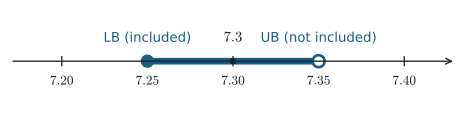
The upper bound is not included because \(7.35\) itself rounds up to \(7.4\). But \(7.35\) is still used as the upper bound in calculations: there is no “largest number below \(7.35\)”.
Bounds of a rounded number Not in the formula booklet
If a value \(x\) is rounded to the nearest unit \(u\) (for example \(u = 0.1\), \(1\) or \(10\)) and the rounded value is \(v\), then
\[ v - \frac{u}{2} \le x < v + \frac{u}{2} . \]
- \(v\): the rounded value that is given
- \(u\): the unit of rounding (the place value of the last digit kept)
- \(x\): the exact (unknown) value
- \(v - \frac{u}{2}\): the lower bound; \(\; v + \frac{u}{2}\): the upper bound
So the bounds are half a unit below and above the rounded value.
Example 3 Write down the lower and upper bounds of each value. Write each answer in the form \(\text{LB} \le x < \text{UB}\), using the letter given.
(a) A mass \(m\) of \(68\) kg, to the nearest kilogram.
(b) A length \(l\) of \(3.40\) m, correct to 3 s.f.
(c) A crowd of \(n = 24\,000\) people, to the nearest thousand.
(d) A concentration \(c\) of \(0.060\) mol per litre, correct to 2 s.f.
(a) \(u = 1\), half a unit is \(0.5\): \(\;67.5 \le m < 68.5\).
(b) The last digit is in the hundredths place, so \(u = 0.01\): \(\;3.395 \le l < 3.405\).
(c) \(u = 1000\): \(\;23\,500 \le n < 24\,500\). (The number of people is a whole number, so in fact \(23\,500 \le n \le 24\,499\).)
(d) The last significant digit is in the thousandths place, so \(u = 0.001\): \(\;0.0595 \le c < 0.0605\).
Bounds in calculations
When we calculate with rounded numbers, the answer also has bounds. Think about which bound of each number makes the answer as large as possible, and which makes it as small as possible.
Bounds of a calculation (for positive numbers \(a\) and \(b\)) Not in the formula booklet
| Calculation | Upper bound | Lower bound |
|---|---|---|
| \(a + b\) | \(\text{UB}_a + \text{UB}_b\) | \(\text{LB}_a + \text{LB}_b\) |
| \(a - b\) | \(\text{UB}_a - \text{LB}_b\) | \(\text{LB}_a - \text{UB}_b\) |
| \(a \times b\) | \(\text{UB}_a \times \text{UB}_b\) | \(\text{LB}_a \times \text{LB}_b\) |
| \(a \div b\) | \(\text{UB}_a \div \text{LB}_b\) | \(\text{LB}_a \div \text{UB}_b\) |
- \(\text{UB}_a\), \(\text{LB}_a\): the upper and lower bounds of \(a\)
- \(\text{UB}_b\), \(\text{LB}_b\): the upper and lower bounds of \(b\)
For a difference or a quotient, the bounds of \(b\) are “crossed”: taking away a small number, or dividing by a small number, gives a large answer.
Example 4 A rectangular field is \(85\) m long and \(52\) m wide. Both measurements are correct to the nearest metre.
(a) Find the lower and upper bounds of the area of the field.
(b) Find the lower and upper bounds of the perimeter of the field.
Length: \(84.5 \le l < 85.5\). \(\quad\) Width: \(51.5 \le w < 52.5\).
(a)
\[ \begin{aligned} \text{LB} &= 84.5 \times 51.5 = 4351.75 \text{ m}^2 \\ \text{UB} &= 85.5 \times 52.5 = 4488.75 \text{ m}^2 \end{aligned} \]
So \(4351.75 \le A < 4488.75\).
(b)
\[ \begin{aligned} \text{LB} &= 2(84.5 + 51.5) = 272 \text{ m} \\ \text{UB} &= 2(85.5 + 52.5) = 276 \text{ m} \end{aligned} \]
So \(272 \le P < 276\).
Example 5 A water tank holds \(250\) litres, correct to the nearest \(10\) litres. Then \(85\) litres, correct to the nearest \(5\) litres, are taken out. Find the lower and upper bounds of the amount of water left in the tank.
In the tank: \(245 \le a < 255\). \(\quad\) Taken out: \(82.5 \le b < 87.5\).
For the largest amount left, start with the most water and take out the least:
\[ \text{UB} = 255 - 82.5 = 172.5 \text{ litres.} \]
For the smallest amount left, start with the least water and take out the most:
\[ \text{LB} = 245 - 87.5 = 157.5 \text{ litres.} \]
So \(157.5 \le \text{water left} < 172.5\) litres.
Example 6 A cyclist rides \(42.6\) km, correct to 1 d.p., in \(1.5\) hours, correct to the nearest \(0.1\) hour.
(a) Find the upper and lower bounds of the cyclist’s average speed.
(b) Hence give the average speed to a suitable degree of accuracy. Justify your answer.
Distance: \(42.55 \le d < 42.65\). \(\quad\) Time: \(1.45 \le t < 1.55\). \(\quad\) Speed \(= \dfrac{d}{t}\).
(a) For the upper bound, divide the largest distance by the smallest time:
\[ \text{UB} = \frac{42.65}{1.45} = 29.41\ldots \approx 29.4 \text{ km h}^{-1} \]
For the lower bound, divide the smallest distance by the largest time:
\[ \text{LB} = \frac{42.55}{1.55} = 27.45\ldots \approx 27.5 \text{ km h}^{-1} \]
(b) To 2 s.f. the bounds are \(29\) and \(27\), which are different. To 1 s.f. both bounds give \(30\). So the only accuracy that we can be sure of is \(30 \text{ km h}^{-1}\) (1 s.f.).
Common errors
| ✗ Wrong | ✓ Right | Why |
|---|---|---|
| \(7.3\) (1 d.p.): bounds \(7.2\) and \(7.4\) | \(7.25 \le l < 7.35\) | Go half a unit each way, not a whole unit. |
| \(0.040\,762 \approx 0.04\) (2 s.f.) | \(0.041\) | Zeros at the start are not significant figures. |
| Largest \(a - b\) is \(\text{UB}_a - \text{UB}_b\) | \(\text{UB}_a - \text{LB}_b\) | Subtracting the smallest \(b\) leaves the most. |
| Largest \(\dfrac{a}{b}\) is \(\dfrac{\text{UB}_a}{\text{UB}_b}\) | \(\dfrac{\text{UB}_a}{\text{LB}_b}\) | Dividing by a smaller number gives a bigger result. |
| Rounding the area to \(108\) before finding the cost | Use \(107.88\) (stored in the GDC) | Rounding in the middle gives a wrong final answer. |
Exercises
1 Round \(6.0497\) to
(a) 1 d.p.
(b) 2 d.p.
(c) 3 s.f.
(d) 2 s.f.
(a) \(6.0\)
(b) \(6.05\)
(c) \(6.05\)
(d) \(6.0\)
In (a) and (d) the zero must be written: it shows the accuracy.
2 Round \(0.007\,315\) to
(a) 1 s.f.
(b) 3 s.f.
(c) 4 d.p.
(a) \(0.007\)
(b) \(0.007\,32\) (the next digit is \(5\), so round up)
(c) \(0.0073\)
3 The population of a city is \(2\,649\,500\). Round this number to
(a) 2 s.f.
(b) 4 s.f.
(a) \(2\,600\,000\)
(b) \(2\,650\,000\) (the digit after \(2649\) is \(5\), so round up)
4 Write down the lower and upper bounds of each value, in the form \(\text{LB} \le x < \text{UB}\).
(a) \(5.6\) cm, correct to 1 d.p.
(b) \(450\) g, correct to the nearest \(10\) g.
(c) \(2.08\) s, correct to 3 s.f.
(a) \(5.55 \le x < 5.65\)
(b) \(445 \le x < 455\)
(c) \(2.075 \le x < 2.085\)
5 A square tile has sides of \(20\) cm, correct to the nearest centimetre. Find the lower and upper bounds of the area of the tile.
\(19.5 \le s < 20.5\). \(\quad\) LB \(= 19.5^2 = 380.25 \text{ cm}^2\), \(\;\) UB \(= 20.5^2 = 420.25 \text{ cm}^2\).
6 Two pieces of wood have lengths \(12.4\) cm and \(8.7\) cm, both correct to 1 d.p. Find the lower and upper bounds of the difference in their lengths.
\(12.35 \le a < 12.45\) and \(8.65 \le b < 8.75\).
UB \(= 12.45 - 8.65 = 3.8\) cm. \(\quad\) LB \(= 12.35 - 8.75 = 3.6\) cm.
7 A lift can safely carry at most \(630\) kg (an exact value). Ten people enter the lift. The mass of each person is \(63\) kg, correct to the nearest kilogram. Is it certain that the lift is safe? Explain your answer.
Each mass is less than \(63.5\) kg, so the total mass is less than \(10 \times 63.5 = 635\) kg.
The upper bound \(635\) kg is more than \(630\) kg. So it is not certain that the lift is safe: the total could be up to \(635\) kg.
8 A metal object has a mass of \(240\) g, correct to the nearest \(10\) g, and a volume of \(31 \text{ cm}^3\), correct to the nearest \(\text{cm}^3\). Density \(= \dfrac{\text{mass}}{\text{volume}}\).
(a) Find the lower and upper bounds of the density.
(b) The density of iron is \(7.87 \text{ g cm}^{-3}\). Could the object be made of iron? Explain.
\(235 \le m < 245\) and \(30.5 \le V < 31.5\).
(a) UB \(= \dfrac{245}{30.5} = 8.032\ldots \approx 8.03 \text{ g cm}^{-3}\). \(\quad\) LB \(= \dfrac{235}{31.5} = 7.460\ldots \approx 7.46 \text{ g cm}^{-3}\).
(b) Yes. \(7.87\) lies between the bounds \(7.46\) and \(8.03\), so the object could be iron. (The data cannot prove that it is iron.)
9 A sprinter runs \(100\) m, correct to the nearest metre, in \(12.3\) s, correct to the nearest \(0.1\) s. Find the greatest and least possible values of her average speed.
\(99.5 \le d < 100.5\) and \(12.25 \le t < 12.35\).
Greatest: \(\dfrac{100.5}{12.25} = 8.204\ldots \approx 8.20 \text{ m s}^{-1}\). \(\quad\) Least: \(\dfrac{99.5}{12.35} = 8.056\ldots \approx 8.06 \text{ m s}^{-1}\).
10 A car uses \(6.8\) litres of petrol per \(100\) km. Petrol costs \(\$2.79\) per litre.
(a) Find the cost of the petrol for a journey of \(237\) km.
(b) Amira rounds the amount of petrol to \(16\) litres before she finds the cost. Find her answer, and comment on it.
(a) Petrol: \(237 \times \dfrac{6.8}{100} = 16.116\) litres. \(\;\) Cost: \(16.116 \times 2.79 = 44.963\,64 \approx \$44.96\).
(b) \(16 \times 2.79 = \$44.64\). This is \(32\) cents too little, because she rounded in the middle of the calculation. She should use the full value \(16.116\).